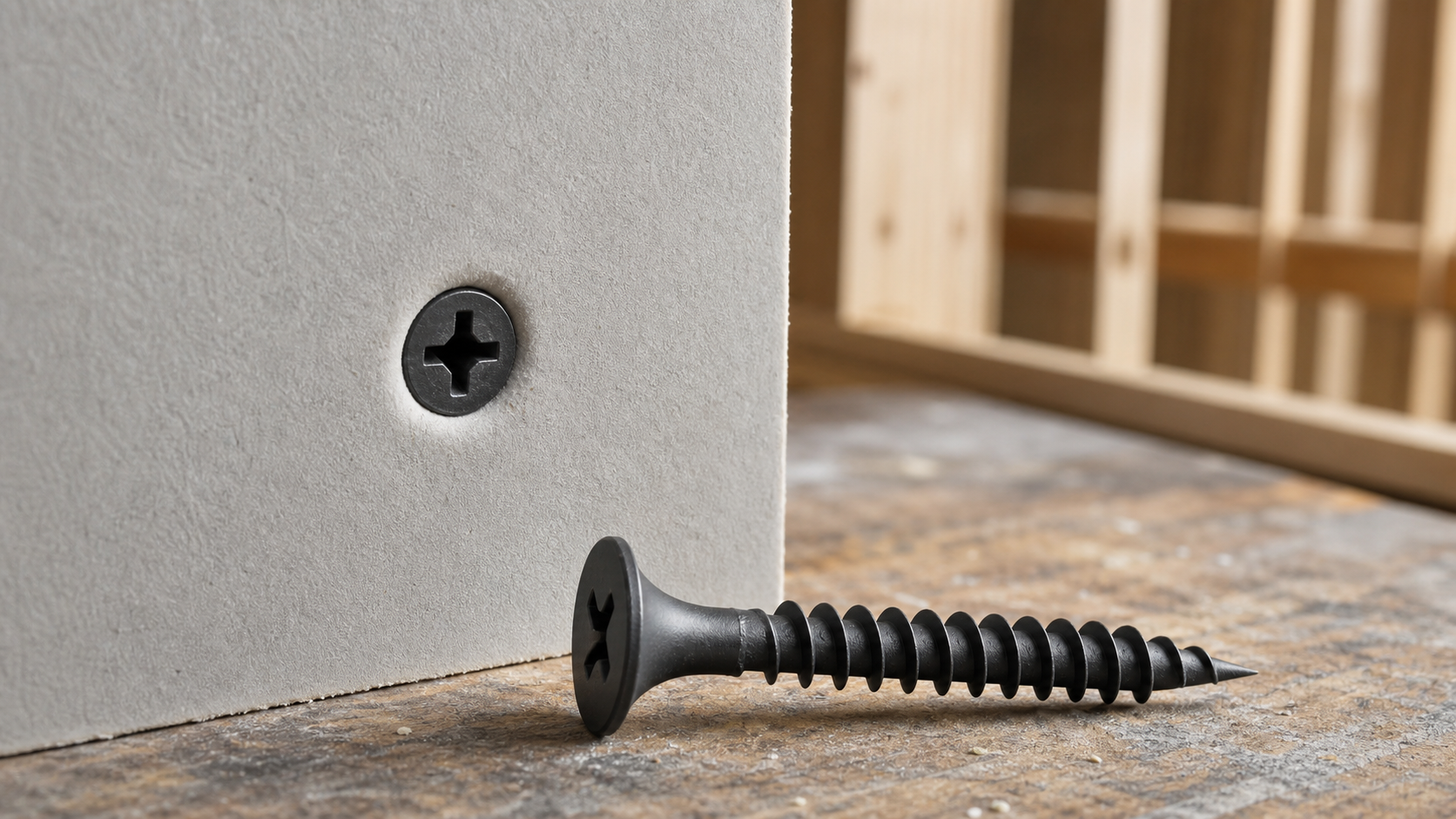
Selecting the right drywall screw for gypsum board applications is a critical decision that affects installation speed, board holding power, and long-term finish quality. For B2B buyers—contractors, distributors, and procurement professionals—understanding the key specification variables helps avoid costly rework and fastener failures. This guide focuses on the practical details that matter: head design, drive recess, thread geometry, tip type, and surface treatment, all tailored for gypsum board attachment to wood or metal framing.
Key Drywall Screw Specifications for Gypsum Board
Drywall screws are engineered with specific features to optimize performance when fastening gypsum board to framing. The following specifications are standard for most gypsum board applications:
- Head: Bugle head – designed to countersink slightly below the board surface without tearing the paper face.
- Drive: Phillips drive recess – provides consistent driver bit engagement and reduces cam-out during high-speed installation.
- Thread: Deep sharp coarse thread – offers strong grip in wood framing and reduces stripping in metal studs when properly selected.
- Tip: Needle-point tip – enables quick penetration and reduces the force required to start the screw.
- Surface Treatment: Black phosphate, galvanized, or customized – each finish offers different levels of corrosion resistance and visual appearance.
These features are not arbitrary; they are the result of decades of field experience and manufacturing refinement. The bugle head, for example, is specifically shaped to create a slight depression in the gypsum board surface, allowing for easy joint compound application without causing paper delamination. The Phillips drive is chosen for its compatibility with common drywall screw guns and impact drivers, ensuring consistent torque transfer.
Understanding the Bugle Head and Phillips Drive
The bugle head is a defining characteristic of drywall screws. Unlike flat or pan heads, the bugle head has a curved underside that distributes bearing pressure over a wider area of the gypsum board face. This reduces the risk of crushing the board core or tearing the paper facing. When driven to the correct depth, the head sits just below the board surface, creating a dimple that can be easily filled with joint compound.
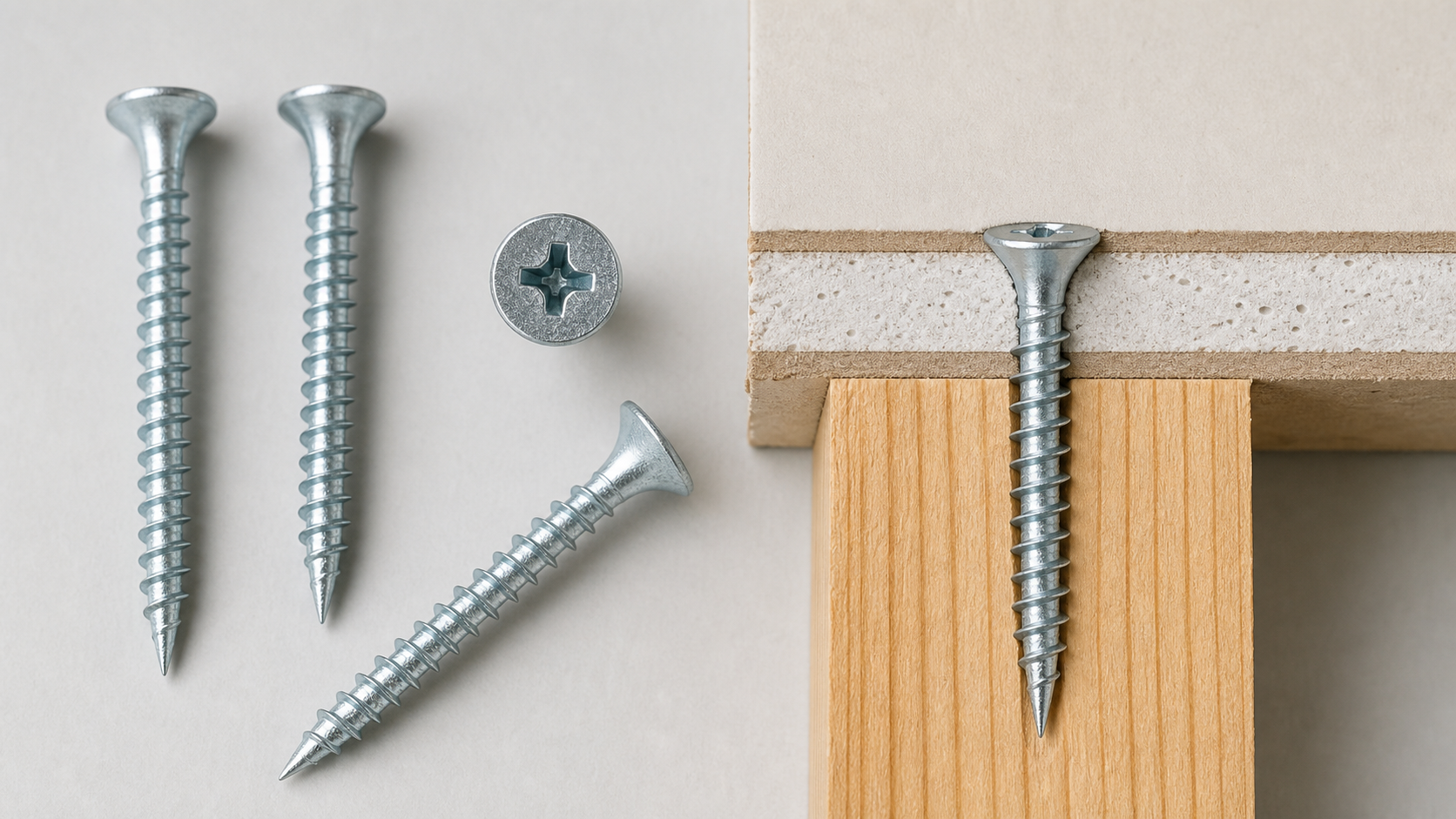
The Phillips drive recess is the industry standard for drywall screws. While other drive types (such as square or Torx) exist, Phillips remains the most widely used due to its self-centering design and compatibility with a broad range of power tools. The cruciform shape allows the driver bit to engage securely, and the recess is designed to allow the bit to slip out (cam-out) when the screw is fully seated, preventing over-torquing and damage to the board.
Thread Design: Coarse vs. Fine Thread for Different Framing
Thread geometry is one of the most important selection criteria for drywall screws. The two primary thread types are coarse thread and fine thread, each suited to different framing materials.
- Coarse thread (deep sharp coarse thread): Designed for wood framing (studs, joists). The deeper threads provide greater holding power in softwoods like pine and fir. The sharp edges cut into the wood fibers, reducing the risk of splitting and ensuring a secure grip.
- Fine thread (not covered in this article but mentioned for context): Typically used for metal framing (steel studs). The finer threads engage better with thin-gauge steel and reduce the risk of stripping the metal.
For gypsum board applications on wood framing, the deep sharp coarse thread is the standard choice. The thread pitch and depth are optimized to pull the board tightly against the framing without over-driving. When using coarse-thread screws in metal studs, the threads may not engage properly, leading to poor holding power. Conversely, fine-thread screws in wood may not achieve sufficient grip. Always match the thread type to the framing material.
Needle-Point Tip: Why It Matters
The needle-point tip is a small but critical feature. A sharp, precisely formed tip reduces the initial force required to penetrate the gypsum board and the framing material. This is especially important when using high-speed screw guns, where a dull tip can cause the screw to wander or skate across the board surface, damaging the paper face.
Needle-point tips also help align the screw with the framing member, reducing the likelihood of the screw deflecting off the stud. For B2B buyers, specifying screws with consistent, sharp needle points can improve installation speed and reduce waste from damaged boards.
Surface Treatment Options and Their Practical Implications
Drywall screws are available with several surface treatments, each offering different levels of corrosion resistance and visual appearance. The choice depends on the environment and the desired finish.
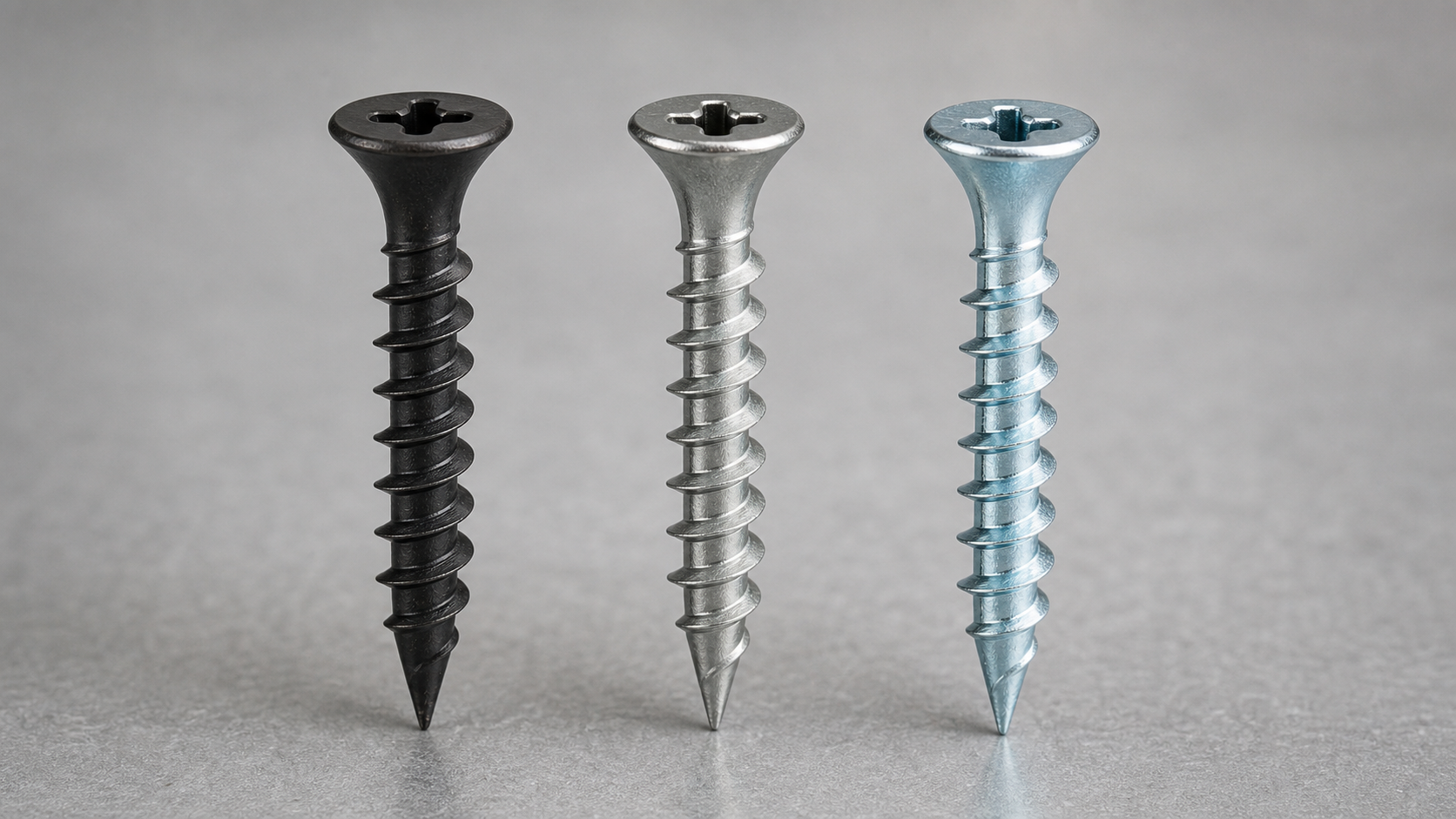
- Black phosphate: A matte black finish that provides moderate corrosion resistance. It is the most common treatment for interior drywall screws. The phosphate coating also acts as a lubricant during driving, reducing friction and heat buildup.
- Galvanized (zinc plating): A silver or bright finish that offers better corrosion resistance than black phosphate. Suitable for areas with higher humidity, such as bathrooms or basements, where moisture exposure is a concern.
- Customized treatments: Some projects require specific finishes, such as electro-zinc plating or even stainless steel for extreme environments. Customization is available based on project requirements.
It is important to note that no surface treatment eliminates the risk of corrosion entirely. For exterior applications or continuous moisture exposure, stainless steel screws (if separately verified) would be required, but this article focuses on standard drywall screws for interior gypsum board use.
Application Checklist for Gypsum Board and Framing
To ensure a successful drywall installation, B2B buyers should verify the following specifications when ordering drywall screws:
- Board type: Confirm that the screw is designed for gypsum board (standard, fire-rated, moisture-resistant, etc.).
- Framing material: Select coarse thread for wood framing, fine thread for metal framing.
- Screw length: Typically, screws should penetrate the framing by at least 5/8 inch (16 mm). For 1/2-inch gypsum board on wood studs, a 1-1/4 inch screw is common. For 5/8-inch board, 1-5/8 inch screws are often used.
- Head style: Bugle head is standard for gypsum board.
- Drive recess: Phillips drive is the industry standard.
- Tip type: Needle-point tip for easy penetration.
- Surface treatment: Black phosphate for dry interior, galvanized for higher moisture areas.
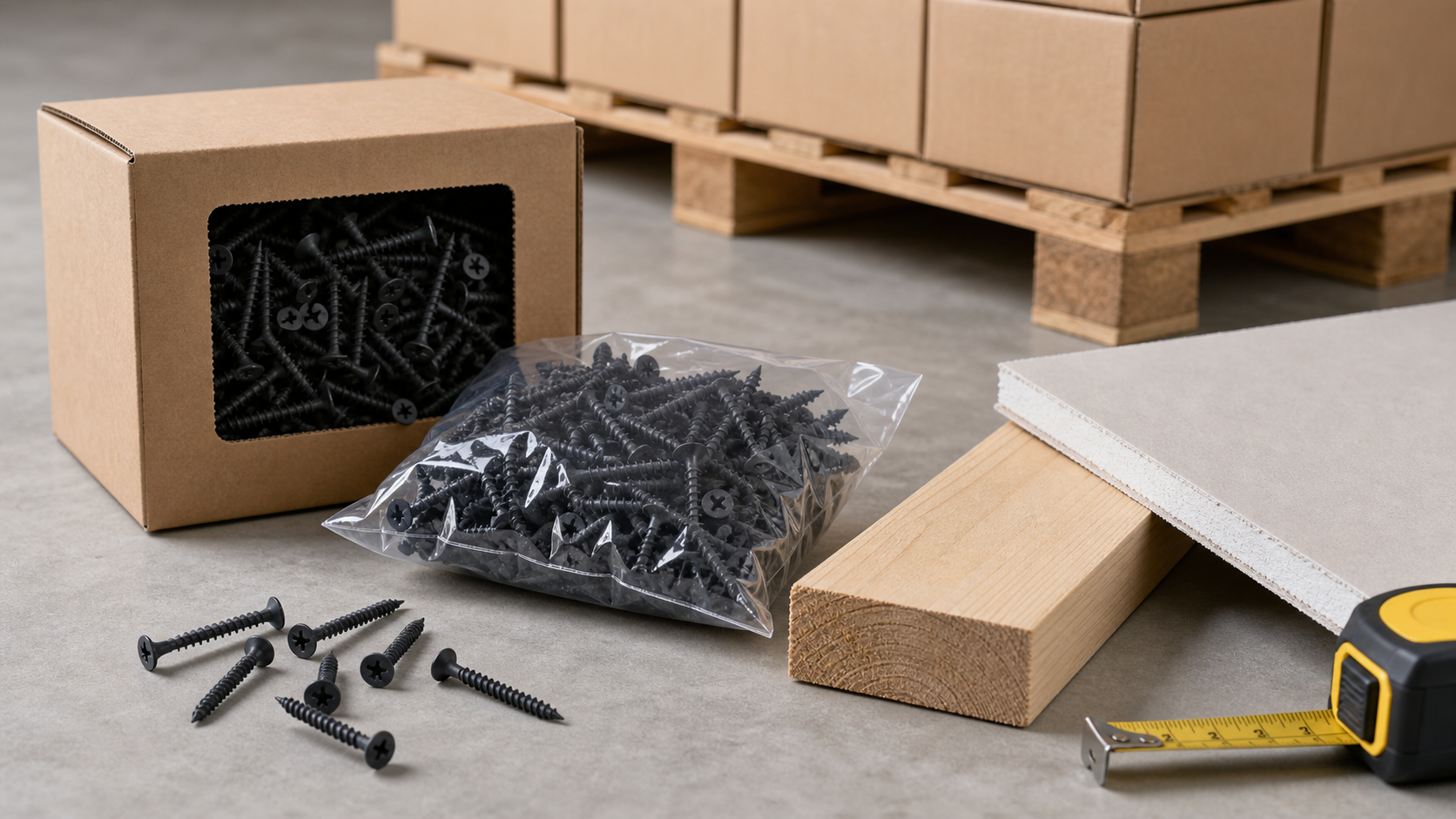
- Packing: Carton, bag, or pallet – choose based on job site handling and storage requirements.
This checklist helps ensure that the screws will perform as expected and meet the project’s requirements. Always request samples or specification sheets from your supplier to verify dimensions and finish.
Common Application Errors to Avoid
Even with the correct screw specifications, installation errors can lead to problems. Here are some common mistakes:
- Over-driving: Driving the screw too deep can break the paper face and reduce holding power. The head should sit just below the surface, creating a dimple.
- Under-driving: Leaving the head above the surface makes joint compound application difficult and can cause nail pops.
- Wrong thread type: Using coarse-thread screws in metal studs can result in poor grip and stripped holes.
- Incorrect length: Screws that are too short may not penetrate the framing adequately; screws that are too long can protrude through the other side.
- Improper spacing: Follow local building codes for screw spacing (typically 12 inches on center for walls, 8 inches for ceilings).
By avoiding these errors, contractors can achieve a smooth, durable finish that meets quality standards.
Comparison Table: Coarse Thread vs. Fine Thread Drywall Screws
| Feature | Coarse Thread | Fine Thread |
|---|---|---|
| Best for framing material | Wood (studs, joists) | Metal (steel studs) |
| Thread depth | Deep, sharp | Shallow, finer |
| Holding power in softwood | High | Low |
| Holding power in thin-gauge steel | Low (may strip) | High |
| Risk of splitting wood | Low (sharp threads cut fibers) | Higher (may wedge) |
| Common application | Gypsum board to wood framing | Gypsum board to metal framing |
| Typical screw length for 1/2″ board | 1-1/4 inch (32 mm) | 1-1/4 inch (32 mm) |
This comparison table helps B2B buyers quickly identify the correct thread type for their framing material. Using the wrong thread can lead to fastener failure, rework, and increased project costs.
Contractor Selection Guidance for Drywall Screws
Choosing the right drywall screw supplier is as important as selecting the correct screw specifications. Here are practical guidelines for B2B buyers:
- Verify material quality: Ensure the screws are made from Q195 or Q235 steel wire, or a customized material that meets your project requirements. Request a material certificate from the supplier.
- Check dimensional consistency: Ask for samples to measure length, diameter, head profile, and thread pitch. Inconsistent dimensions can cause installation problems.
- Assess surface treatment uniformity: The coating should be even, without bare spots or excessive buildup. Black phosphate should be matte and uniform; galvanized finishes should be smooth and free of rough edges.
- Evaluate packing options: For large projects, bulk pallets reduce per-unit cost. For smaller jobs, cartons or bags are easier to handle. Ensure packing is robust enough to prevent damage during transport.
- Confirm lead times and minimum order quantities: Discuss delivery schedules and MOQs upfront to avoid project delays.
- Request a specification sheet: A detailed spec sheet should list material, dimensions, thread type, tip type, head style, drive recess, surface treatment, and packing details.
- Consider customization: If your project requires non-standard lengths, diameters, or finishes, verify that the supplier can accommodate custom orders.
By following these guidelines, B2B buyers can select a reliable supplier that delivers consistent, high-quality drywall screws for gypsum board applications.
Limitations of Standard Drywall Screws
While drywall screws are optimized for gypsum board attachment, they have limitations that B2B buyers should understand:
- Not for structural loads: Drywall screws are designed for shear loads from the weight of the board, not for supporting heavy fixtures or structural elements. Use appropriate anchors or structural screws for hanging cabinets, shelves, or light fixtures.
- Limited corrosion resistance: Standard black phosphate and galvanized finishes are suitable for interior environments. For exterior applications, high-humidity areas, or direct water exposure, stainless steel screws (if separately verified) or specialized corrosion-resistant fasteners are required.
- Not for all board types: While suitable for standard, fire-rated, and moisture-resistant gypsum board, drywall screws may not perform well with cement board, fiber-cement siding, or other dense materials. Use specialized fasteners for those applications.
- Thread type specificity: Coarse-thread screws are not interchangeable with fine-thread screws. Using the wrong thread type can result in poor holding power, stripped holes, or board damage.
- No certified load ratings: Drywall screws are not typically tested or certified for specific load capacities. Always consult local building codes and engineering specifications for structural requirements.
Understanding these limitations helps B2B buyers avoid misapplication and ensures that drywall screws are used only where appropriate.
Frequently Asked Questions
1. Can drywall screws be used for both wood and metal framing?
Drywall screws are typically designed for one type of framing. Coarse-thread screws are for wood framing, while fine-thread screws are for metal framing. Using the wrong type can result in poor holding power. Always match the thread to the framing material.
2. What is the standard length of drywall screws for 1/2-inch gypsum board?
For 1/2-inch gypsum board attached to wood studs, a 1-1/4 inch (32 mm) screw is commonly used. For 5/8-inch board, 1-5/8 inch (41 mm) screws are typical. The screw should penetrate the framing by at least 5/8 inch.
3. Are black phosphate drywall screws suitable for bathrooms?
Black phosphate provides moderate corrosion resistance and is suitable for dry interior applications. For bathrooms or areas with high humidity, galvanized (zinc-plated) screws are recommended for better moisture resistance.
4. What is the difference between bugle head and flat head screws?
Bugle head screws have a curved underside that distributes pressure over a wider area, reducing the risk of tearing the gypsum board paper face. Flat head screws do not have this curved profile and are not recommended for drywall applications.
5. How should drywall screws be packed for job site use?
Drywall screws are commonly packed in cartons, bags, or on pallets. For job site convenience, smaller boxes or bags are easier to handle, while bulk pallets are cost-effective for large projects. Custom packing options are available from many suppliers.
6. What is the maximum screw spacing for gypsum board ceilings?
Local building codes typically require screws to be spaced 12 inches on center for walls and 8 inches on center for ceilings. Always verify with your local code authority, as requirements may vary.
7. Can drywall screws be used with metal studs if I use a different tip?
No. The tip type (needle-point) is standard for both wood and metal framing, but the thread type must match the framing material. For metal studs, use fine-thread screws. Using coarse-thread screws in metal studs will result in poor grip, even with a needle-point tip.
Inquiry Checklist for B2B Buyers
When sourcing drywall screws for gypsum board applications, use the following checklist to communicate your requirements to suppliers:
- Material: Q195 / Q235 steel wire or customized material
- Length: Specify exact length in inches or millimeters
- Diameter: Specify gauge or diameter
- Head: Bugle head
- Drive: Phillips drive recess
- Thread: Deep sharp coarse thread (for wood framing)
- Tip: Needle-point tip
- Surface treatment: Black phosphate / galvanized / customized
- Packing: Carton / bag / pallet / customized export packing
- Quantity: Total pieces or weight
- Certifications: If required, specify (note: not all certifications are available; verify with supplier)
Providing clear specifications helps suppliers deliver the right product and reduces the risk of miscommunication.
Get a Quote for Your Drywall Screw Requirements
Ready to order drywall screws for your next gypsum board project? Contact our team with your specifications, and we will provide a competitive quote tailored to your needs. Whether you require standard black phosphate screws for interior work or galvanized screws for moisture-prone areas, we can supply the right product in the quantities you need.
Email us at sales@haoyuequan.com or call +86-574-88888888 to discuss your requirements. Include your inquiry checklist details for a faster response. We look forward to partnering with you on your next project.